ATS manual updates: the placement killer you ignore
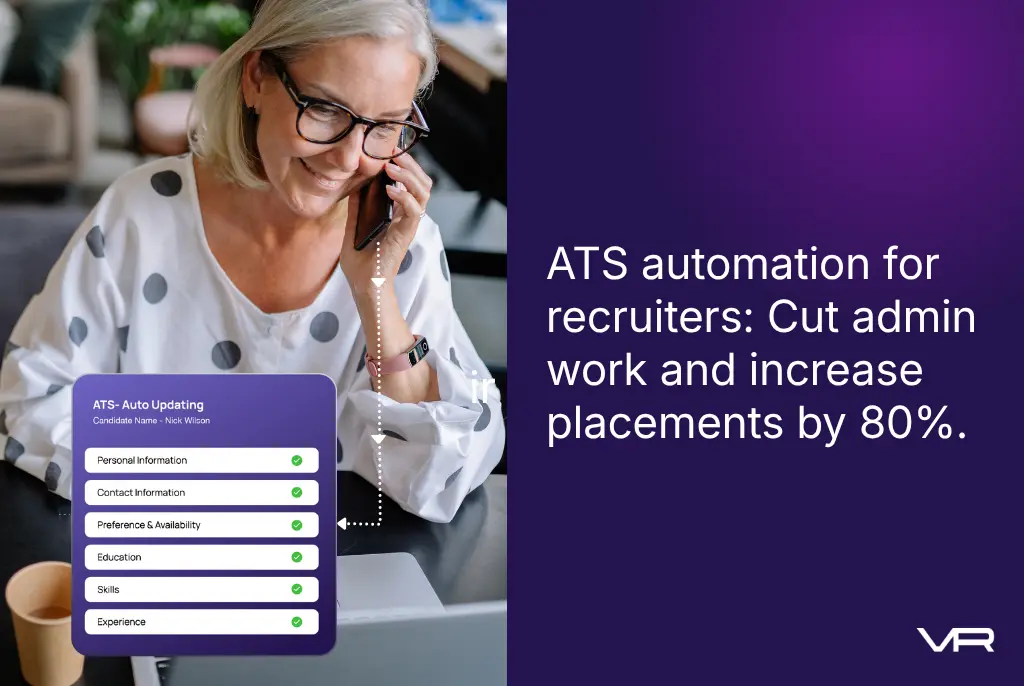
Manual data entry eats 20–40% of your recruiters’ time, and this is exactly where ATS automation for recruiters becomes critical. Instead of spending hours updating candidate statuses, reformatting resumes, and logging notes, recruiters can focus on placements and revenue-driving activities. Research shows recruiters lose one to two days weekly to administrative tasks, with manual ATS updates being a primary culprit.
This hidden workflow bottleneck directly impacts your bottom line. While your team wrestles with spreadsheets and duplicate data entry, competitors who’ve automated their ATS workflows are placing candidates faster.
We’ll examine the real cost of manual updates, backed by industry data, and provide actionable solutions you can implement immediately to reclaim lost productivity and revenue.
The true cost of manual ATS updates
Lost recruiter productivity
Your recruiters entered this field to build relationships and make placements. Instead, they’re spending up to 40% of their time on tasks that could be automated. Manual status updates, data entry, and resume reformatting consume hours that should focus on revenue-generating activities.
Consider what happens when a recruiter screens 50 candidates for a single role. Each requires:
- Creating candidate records
- Logging screening notes
- Updating pipeline stages
- Formatting submittal packages
- Scheduling interviews
- Recording feedback
Without automation, these tasks can take 10-15 minutes per candidate. That’s over 12 hours of administrative work for just one position.
Candidate drop-off rates
Speed wins in today’s talent market. Application abandonment rates range from 50% to 92%, with delayed communication being a major factor. When your ATS requires manual updates, candidates wait days for responses while automated competitors engage within hours.
The impact compounds at each stage:
- Initial application: 60% abandon if the process takes over 20 minutes
- Post-screening: 40% withdraw after one week without updates
- Interview stage: 23% accept other offers while waiting for feedback
Every manual touchpoint increases the risk of losing qualified candidates to faster-moving firms.
Where manual processes break down
Sourcing to submittal delays
The journey from identifying a candidate to submitting them for a role should be seamless. Manual ATS processes create unnecessary friction at every step. Recruiters juggling multiple requisitions often resort to personal spreadsheets, creating data silos that hurt collaboration and visibility.
When submittal packages require manual assembly, quality suffers. Recruiters rushing to meet deadlines may skip important candidate context or submit outdated resumes. These shortcuts damage client relationships and reduce placement rates.
Interview scheduling chaos
Data accuracy issues
Manual data entry introduces errors that cascade through your recruitment process. Duplicate records, outdated contact information, and inconsistent formatting make it harder to:
- Search your talent database effectively
- Track sourcing channel performance
- Generate accurate pipeline reports
- Maintain compliance documentation
Poor data quality also undermines ATS optimization efforts, as even the best ATS software can’t overcome garbage inputs.
Real-world impact: a case study
Talent Burst faced a common challenge: growing placement demands without proportional headcount increases. Their recruiters spent excessive time on manual ATS updates, limiting their capacity to engage new candidates.
After implementing automated workflows and virtual recruiting technology, they achieved remarkable results:
- 700+ placements in 12 months
- 40% year-over-year placement growth
- $18.5 million revenue impact
- 14% of placements completed hands-free
- 200+ weekly submissions
The key? Eliminating manual bottlenecks that previously consumed 30% of recruiter time. Automated status updates, integrated scheduling, and AI-assisted candidate matching freed their team to focus on relationship building and strategic account management.
Practical solutions for ATS automation for recruiters
Quick wins you can implement this week
Start with high-impact changes that deliver immediate results:
1. Auto-status rules
Configure your ATS to automatically advance candidates based on triggers:
- Email opened = “Engaged”
- Assessment completed = “Qualified”
- Interview scheduled = “In Process”
2. Template libraries
Build reusable templates for:
- Initial outreach messages
- Interview confirmations
- Rejection notifications
- Reference check requests
3. Calendar integration
Connect your ATS directly to recruiters’ calendars. Two-way sync eliminates double-booking and automatically updates candidate records when meetings occur.
Medium-term process improvements
Workflow mapping
Document your current recruitment process from application to placement. Identify every manual touchpoint and prioritize automation opportunities based on:
- Frequency of the task
- Time required per instance
- Error rate potential
- Impact on candidate experience
Integration strategy
Modern ATS software works best as part of a connected ecosystem. Prioritize integrations with:
- Sourcing platforms for automatic candidate import
- Assessment tools for seamless testing workflows
- Background check providers for faster onboarding
- VMS systems for client-side automation
Data governance
Establish clear standards for:
- Required vs. optional fields
- Naming conventions
- Status definitions
- Owner responsibilities
Clean data enables better automation and reporting while reducing duplicate effort.
Measuring success and ROI
Track these key metrics to quantify the impact of reducing manual ATS work:
Metric | Baseline target | After automation |
|---|
Admin time per placement | 8–12 hours | 2–4 hours |
Time to submittal | 3–5 days | Same day |
Candidate response rate | 20–30% | 50–70% |
Placement rate | Industry avg 20% | 25–35% |
Taking action to eliminate ATS bottlenecks
Manual ATS updates represent a hidden tax on any modern staffing firm’s recruitment capacity. Every hour spent on data entry is an hour not spent building relationships, qualifying candidates, or closing placements. This is why ATS automation for recruiters is becoming a must-have for any staffing organization looking to stay competitive.
Start small with quick wins that demonstrate value. Map your workflows to identify the highest-impact automation opportunities. Invest in integrations that connect your tech stack. Most importantly, measure results to build momentum for continued optimization.
Forward-thinking staffing firms are already reaping the benefits of automation. Those who continue relying on manual processes risk falling further behind as talent markets tighten and client expectations rise. Solutions like ConverzAI’s virtual recruiter can handle routine screening and engagement tasks, freeing your team to focus on strategic activities that drive growth.
Ultimately, ATS automation for recruiters is not just about saving time – it’s about unlocking the full potential of your staffing business. The firms that win in staffing will be the ones that combine human expertise with intelligent automation to deliver faster, smarter, and more scalable hiring outcomes.
The choice is clear: continue losing placements to manual bottlenecks or embrace automation to compete effectively in modern recruitment.
FAQs